
Economic growth
Increase in a society's production of goods and services.

DavidMCEddy · CC BY-SA 4.0
Economic growth is an increase in the quantity and quality of the economic goods and services that a society produces. It is typically measured as the increase in inflation-adjusted output, such as real GDP or real GDP per capita, and focuses on the economic activities of a country. Economists distinguish between intensive growth, caused by more efficient use of inputs, and extensive growth, caused only by increases in the amount of inputs.
- field
- Economics
- known_for
- Increase in real GDP per capita and productivity as primary drivers of economic growth
- key_concept
- Intensive vs. extensive growth
- measurement
- Real GDP growth rate, real GDP per capita growth rate, GNI per capita growth, median income growth
Lore & Background
Economic growth is measured using national income accounting, with the rate typically calculated as the geometric annual rate of growth in GDP or GDP per capita over a period. This growth rate represents the trend in average GDP, ignoring short-term fluctuations. Short-term changes, including recessions, occur around long-term trends but are unpredictable. Increases in labor productivity have historically been the most important source of real per capita economic growth; MIT Professor Robert Solow estimated that technological progress accounted for 80 percent of the long-term rise in U.S. per capita income, with increased capital investment explaining the remaining 20 percent. Before industrialization, technological progress led to population increases kept in check by food supply, a condition known as the Malthusian trap. The rapid growth during the Industrial Revolution exceeded population growth, allowing escape from this trap, and industrialized countries later saw population growth slow in a demographic transition.
Reader's Guide
Economic growth is significant because it represents the expansion of a society's productive capacity and material well-being. The source article emphasizes that productivity improvements—especially from technological innovation, division of labor, and mechanization—have been the major factor behind per capita growth since the mid-19th century. During the Industrial Revolution, mechanization and new processes for chemicals, iron, and steel transformed manufacturing. The Second Industrial Revolution saw inanimate power replace human and animal labor, with steam and internal combustion engines greatly expanding total power. Later, mass production, automation, transportation infrastructure, and new materials like steel further boosted productivity. Economic growth slowed in the U.S. Capital investment, subject to diminishing returns, also drives growth, as seen in several Asian countries. The work week declined over the 19th century and was reduced to 40 hours in the U.S.
Did You Know?
- MIT Professor Robert Solow concluded that technological progress accounted for 80 percent of the long-term rise in U.S. per capita income.
- Over the 20th century, the real price of many goods fell by over 90% due to productivity increases.
Measuring the Engine of a Nation's Output
Economic growth, at its core, captures how a society produces more and better goods and services over time. Rather than simply tracking raw dollar figures, economists strip away the noise of inflation to reveal genuine expansion in output. The most common yardstick is the real GDP growth rate, though analysts also look at real GDP per capita, GNI per capita, and even median income to paint a fuller picture. The "rate" itself is a geometric annual figure calculated between the first and last year of a chosen period, smoothing out the year-to-year swings that accompany recessions and booms. Behind every calculation sits the framework of national income accounting, which breaks per capita output into labor productivity, hours worked, workforce participation, and demographic composition. By dividing a country's total GDP by its population, economists isolate whether growth is lifting everyone's standard of living or merely reflecting a larger headcount. This inflation-adjusted, per-capita lens is what separates meaningful prosperity from the illusion of rising prices.
Two Paths to Expansion — Intensive versus Extensive Growth
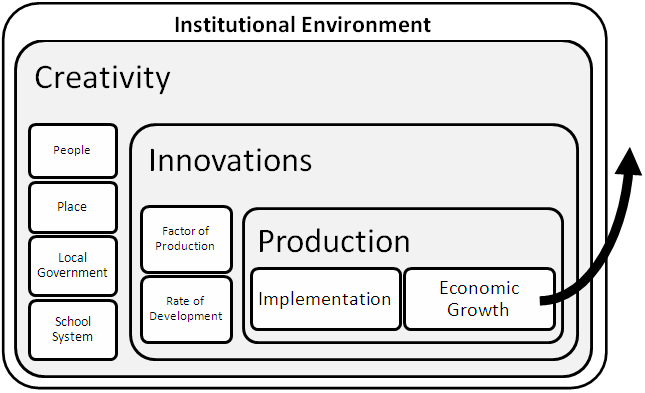
Economists draw a sharp line between two fundamentally different engines of growth. Intensive growth arises when the same inputs are used more efficiently — when labor becomes more productive, when physical capital yields more per unit, when energy and materials are consumed more sparingly. Extensive growth, by contrast, simply reflects having more inputs to work with: a larger population, newly acquired territory, or additional land brought under cultivation. While both pathways raise total output, only intensive growth reliably lifts per capita living standards. Innovation sits at the intersection of both, generating entirely new categories of goods and services. This means the modern economy is not merely producing more of the old things faster; it is continuously inventing new things that did not previously enter the marketplace at all.
Productivity, the Malthusian Trap, and the Long Escape
For most of human history, technological gains were swallowed by population growth. The Malthusian trap described a world in which any improvement in food supply or productive capacity simply supported more people, keeping per capita income pinned near subsistence levels. The Industrial Revolution shattered that equilibrium for the first time, because output grew faster than the population that consumed it. MIT economist Robert Solow later quantified how central this shift was, estimating that technological progress drove roughly eighty percent of the long-run rise in American per capita income, while additional capital investment accounted for only the remaining twenty percent. Since the mid-nineteenth century, the dominant source of per capita growth has been producing more output per unit of labor, materials, energy, and land. The further division of labor and specialization amplified these gains. As industrialized nations eventually saw their population growth slow — a pattern called the demographic transition — the per capita benefits of productivity improvements became even more pronounced, cementing productivity as the single most important driver of sustained real growth.
From Steam to Silicon — A Century of Productivity Leaps
The late nineteenth and early twentieth centuries witnessed a cascade of productivity breakthroughs that reshaped daily life. Railroads, steam ships, horse-pulled reapers, combine harvesters, and steam-powered factories multiplied the output of every worker. The development of cheap steel-making processes unlocked mechanization across manufacturing and transportation. During the Second Industrial Revolution, inanimate power — steam, internal combustion engines, and eventually electricity — replaced human and animal muscle, and continuous improvements in energy conversion efficiency expanded total available power far beyond what wind and water could provide. Machine tools made interchangeable metal parts economical, and by the 1920s this logic had evolved into mass production. The results were tangible: over the course of the twentieth century, the real price of many goods fell by more than ninety percent, weekly work hours declined, and real wages rose enough for workers to improve their diets, purchase consumer goods, and afford better housing. Later additions — television, air conditioning, commercial aviation, and the Green Revolution's chemical fertilizers and scientific livestock management — continued this trajectory of doing more with less.
Gallery



Frequently Asked Questions
Who is Economic growth?
Economic growth is the concept describing how a society produces more and better goods and services over time. It is tracked primarily through inflation-adjusted output metrics such as real GDP or real GDP per capita.
What are Economic growth's powers/role?
Its central role is to capture the rise in a country's productive capacity, measured by growth rates in real GDP, real GDP per capita, GNI per capita, and median income. It serves as the main yardstick for whether a nation's economic engine is genuinely expanding.
How does Economic growth's story end?
The concept has no fixed endpoint, but economists split its narrative into two arcs: intensive growth, where the same inputs yield more output through greater efficiency, and extensive growth, where output rises simply because more inputs are added. A society's long-term trajectory hinges on shifting from the latter to the former.
Why is Economic growth important?
It is the primary driver behind rising living standards, since higher real GDP per capita and productivity translate into more goods and services available to each person. Without it, a population's average material well-being stalls or declines.
What are Economic growth's key relationships?
Its two main subtypes—intensive and extensive growth—represent fundamentally different mechanisms: one relies on efficiency gains while the other merely adds more labor, capital, or land. Distinguishing between them helps policymakers target the right levers for sustainable expansion.
More in Economic Concepts 1-15
Spotted an error? Know more?
This is a living reference — every entry is fact-audited, and reader corrections feed straight into our audit queue. Suggest an edit · See this site's audit record