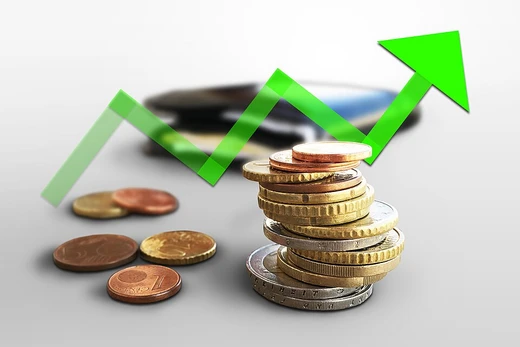
Deflation
A sustained fall in the general price level of goods and services.

Wikimedia Commons · CC BY 4.0
Deflation is an economic phenomenon characterized by an increase in the real value of the monetary unit of account, reflected in a sustained decrease in the general price level of goods and services. It is considered a monetary phenomenon, explainable by changes in money supply and velocity relative to spending on output, and is distinct from disinflation, which is merely a slowdown in inflation. Deflation occurs when the inflation rate falls below zero, increasing the purchasing power of currency but also raising the real value of debt, which can stress financial sectors and aggravate recessions.
- definition
- Increase in real value of monetary unit, reflected in falling general price level
- distinction
- Deflation is distinct from disinflation (a slowdown in inflation)
- inflation threshold
- Occurs when inflation rate falls below 0% and becomes negative
- effect on currency
- Increases purchasing power of currency over time
- effect on debt
- Increases real value of debt, especially if unexpected
- associated risk
- Can aggravate recessions and lead to a deflationary spiral
Lore & Background
Different types of deflation include growth deflation (from technological progress and competitive price cuts), bank credit deflation (from bank failures or reduced credit supply), debt deflation (associated with the end of long-term credit cycles, as theorized by Irving Fisher), and money supply-side deflation (from reduced velocity of money or money supply per person). In modern credit-based economies, deflation may be triggered by central banks raising interest rates, which can pop asset bubbles and reduce lending.
Reader's Guide
Deflation's significance lies in its dual nature: while it increases the purchasing power of currency, it also raises the real burden of debt, potentially destabilizing financial systems and deepening recessions. Economists generally view a larger deflationary shock as problematic in modern economies because it can stress lenders who finance loans with short-term funds, as the cost of those funds may exceed returns from holding money. The deflationary spiral—where delayed purchases reduce aggregate demand, idling productive capacity and lowering investment—poses a challenge that may require economic stimulus, such as increased government spending or central bank money supply expansion. Historical episodes, such as the deflation during the Great Depression, illustrate how monetary policy mistakes can exacerbate deflation. Under fiat monetary systems with low productivity growth, deflation is less expected aside from speculative asset collapses. The concept remains central to macroeconomic policy debates, particularly regarding the risks of debt deflation and the limitations of zero or negative interest rates in stimulating economies.
Did You Know?
- Deflation is distinct from disinflation, which is a slowdown in the inflation rate while inflation remains positive.
- In a deflationary spiral, consumers delay purchases expecting further price falls, reducing overall economic activity.
- Ben Bernanke's studies of the Great Depression indicated that the Federal Reserve decreased the money supply in response to decreased demand, contributing to deflation.
What Deflation Actually Means
Deflation, in its most precise economic sense, refers to a sustained rise in the real purchasing power of a currency, observable through a broad-based decline in the general price level of goods and services. It is fundamentally a monetary phenomenon: the rate at which prices change is determined by how the growth of some monetary aggregate compares with the trend growth of real output, once adjusted for changes in the velocity of money. This sets deflation apart from the often-confused concept of disinflation, which merely describes a slowing pace of inflation while the rate remains positive. True deflation arrives only when the inflation rate dips below zero. The practical consequence is a double-edged one. On the favorable side, a given sum of currency can now command more goods and services than it could previously. On the painful side, anyone holding fixed nominal obligations—loans, bonds, wage contracts—must now sell more output to generate the same dollar amount needed to service those debts. In this way, deflation quietly reshuffles the distribution of wealth between debtors and creditors, making it a phenomenon with profound implications for the broader financial architecture.
The Spiral and the Stress on Credit
Economists broadly agree that a significant deflationary shock poses serious dangers to a modern economy, primarily because it inflates the real burden of outstanding debt—particularly when the price decline is unanticipated. The financial sector feels this pressure acutely. Institutions that fund lending by borrowing short-term currency find themselves squeezed: the cost of those funds climbs above whatever return can be earned simply by holding cash, which is now appreciating. This dynamic can aggravate an existing recession and cascade into a self-reinforcing deflationary spiral. The mechanism is intuitive. As prices fall, consumers rationally postpone purchases, expecting further discounts. That delay idles productive capacity, suppresses investment, and erodes aggregate demand even further, inviting additional price cuts. Risk aversion compounds the problem: investors and households begin hoarding money precisely because its value is rising, potentially trapping the economy in a liquidity trap. Central banks face a structural constraint—they generally cannot set negative interest rates, and even zero rates often deliver less stimulus than modestly positive ones. In a closed economy, zero rates imply zero or negative returns on short-maturity government securities. In an open economy, they trigger carry trades that devalue the currency and raise import prices without proportionally boosting exports.
Causes: From Productivity Gains to Credit Contractions
In mainstream economic analysis, deflation emerges from an interplay between the supply and demand for goods and services and the parallel supply and demand for money. Within the IS–LM framework, it manifests as a shift in the equilibrium curves, triggered by an increase in supply, a decline in demand, or some combination of both. On the demand side, two principal drivers stand out: growth deflation, in which technological progress permanently lowers the real cost of production and competitive firms pass those savings on as lower prices—thereby actually expanding aggregate demand—and hoarding, where risk-averse agents simply sit on appreciating cash. On the supply side, the culprits include bank credit deflation, debt deflation, deliberate decisions to contract the money supply, and broader credit deflation. Deflation can also be understood as the natural state of an economy whose money supply is fixed or grows more slowly than population and output; in that case, hard currency per capita effectively becomes scarcer, and each unit commands more purchasing power. Improvements in production efficiency and falling transportation costs similarly push prices down, especially when competition compels firms to share cost savings with consumers rather than pocketing them as profit.
A Century of Episodes: From the Gold Era to the Fiat World
The historical record shows that deflation is not a single phenomenon but a recurring pattern shaped by the monetary regime. Yet deflation returned at the war's end and again during the 1930s depression. Research by Ben Bernanke on the Great Depression indicated that the Federal Reserve of that era reduced the money supply in response to falling demand, worsening the deflation. Japan's early-1990s experience is cited as a parallel case, where declining goods demand combined with a shrinking money supply. Most nations abandoned the gold standard during the 1930s, and under subsequent fiat monetary systems—such as the high-productivity-growth period from the end of World War II through the 1960s—deflation did not recur despite output gains. With the gold standard gone, economists see less reason to expect deflation under a fiat system with productivity growth, though the collapse of speculative asset classes remains a trigger.
Gallery


Frequently Asked Questions
What is Deflation?
Deflation is an economic condition in which the purchasing power of money rises because the overall price level of goods and services drops over time. It is fundamentally a monetary phenomenon, driven by shifts in money supply and spending velocity relative to the economy's output.
How is Deflation different from Disinflation?
Disinflation simply means the pace of inflation is slowing, while Deflation means prices are actually falling. Deflation kicks in only when the inflation rate dips below zero and turns negative.
What does Deflation do to your money and your debt?
Each unit of currency buys more over time, boosting consumers' purchasing power. At the same time, the real value of outstanding debt rises, which can squeeze borrowers and put significant stress on financial institutions.
Why do economists worry so much about Deflation?
A sustained decline in prices can push consumers to postpone purchases, which further suppresses demand and deepens a recession. This self-reinforcing feedback loop is called a deflationary spiral and is regarded as one of the most damaging macroeconomic traps.
Can Deflation ever be a positive thing?
In mild, short-lived cases, falling prices can benefit consumers by increasing their real purchasing power. However, when the drop is unexpected and sustained, the growing burden of debt and the risk of a deflationary spiral make the overall impact far more harmful than helpful.
More in Economic Concepts 1-15
Spotted an error? Know more?
This is a living reference — every entry is fact-audited, and reader corrections feed straight into our audit queue. Suggest an edit · See this site's audit record